











Realtime Software
Students learn how software interacts with hardware, sensors, networks, databases, and other digital components. The subject develops an understanding of system responsiveness, task scheduling, resource management, communication, and reliability.



Realtime Software
Our Real-Time Software course focuses on developing applications that process data and respond instantly within strict time constraints. The course covers key concepts such as real-time operating systems (RTOS), embedded systems, multitasking, scheduling, and time-critical programming. It helps learners understand how software is designed for systems where timing and accuracy are crucial, such as in automation, robotics, and communication systems.
Aim
- To develop skills in real-time programming for building applications that respond quickly and operate within strict time constraints.
- To prepare learners for embedded and real-time system careers by providing practical knowledge of RTOS, scheduling, and system design.
-
Real-Time Systems: Understanding systems that process information and respond within defined time constraints.
-
Task Scheduling: Learning how multiple tasks are organised and executed efficiently.
-
System Responsiveness: Understanding how software responds to inputs and events in a timely manner.
-
Software Design: Exploring structured approaches for developing reliable real-time applications.
-
Data Processing: Learning how information can be collected and processed efficiently.


Practical Learning
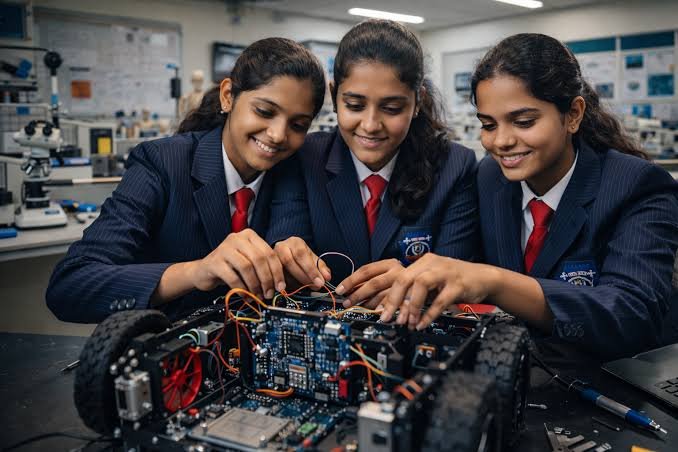
Practical learning helps students connect theoretical concepts with real-world applications. Through laboratory exercises, programming tasks, demonstrations, assignments, and projects, students can explore how real-time software responds to changing inputs and system events.
Courses Offered
Regular
- Introduction to Real-Time Systems and Concepts
- Basics of Embedded Systems and Programming
- Understanding time constraints and system responses
Specialization
- Real-Time Operating Systems (RTOS)
- Embedded Systems & IoT Development
- Real-Time Application Design & Scheduling
Working Professionals
- Flexible Learning Schedule
- Hands-on training with industry tools and systems
- Career-oriented skills for embedded and real-time roles
Advanced Business Analytics
- Working with Real-Time Operating Systems (RTOS)
- Task scheduling and performance optimization
- Development of real-time applications and projects
Realtime Software – Overview
Real-Time Software is a specialised area of computer science concerned with systems that process information and respond to events within defined time requirements. At Fullinfaws College, students are introduced to the principles that make software responsive, reliable, and suitable for applications where timely processing is important.
The subject helps learners understand how software interacts with users, devices, sensors, networks, and other computing components. Students explore concepts such as event handling, task scheduling, concurrency, system timing, resource management, communication, and software reliability.
Learning also introduces students to the importance of designing systems that can manage multiple operations efficiently while maintaining predictable performance. Through conceptual lessons and practical examples, learners understand how real-time principles are applied in modern technological environments.
Real-time software has applications in embedded systems, robotics, industrial automation, transportation, telecommunications, healthcare technology, monitoring systems, and smart devices. The subject therefore provides students with a foundation for understanding software that must respond accurately and efficiently to changing conditions.
The programme encourages logical thinking, programming skills, systematic problem-solving, and responsible software development, helping students prepare for further learning and technology-oriented professional opportunities.
Realtime Software – Activities
Activities in Real-Time Software are designed to give students practical experience in understanding how software responds to events and manages tasks within defined time requirements. The learning environment encourages students to experiment, analyse system behaviour, and develop solutions through practical exercises.
Students may participate in programming exercises focused on event handling, task management, scheduling, process coordination, and system monitoring. Laboratory sessions can include simulations that demonstrate how real-time applications respond to different inputs and changing conditions.
Project-based learning provides opportunities to develop small applications and study practical scenarios involving automation, monitoring, communication, and device interaction. Students can also participate in technical presentations, group discussions, workshops, coding exercises, and demonstrations.
Debugging and testing activities help learners identify errors, examine system performance, and improve software reliability. Team-based assignments encourage collaboration and communication while individual tasks strengthen independent problem-solving.
These activities are intended to connect theoretical concepts with practical application. Through continuous practice, students develop programming confidence, analytical thinking, technical accuracy, troubleshooting abilities, and an understanding of responsible software development.
Realtime Software – Departments
The Real-Time Software department at Fullinfaws College provides an academic platform for students to explore software systems that require timely processing, reliable operation, and efficient resource management. The department combines computer science concepts with practical approaches to modern software development.
The academic structure covers areas related to programming, system design, operating concepts, task scheduling, software communication, embedded applications, testing, and system performance. Students are guided through classroom instruction, laboratory sessions, assignments, projects, and academic discussions.
Faculty members support learners in developing a clear understanding of how software operates within different computing environments. Students are encouraged to examine practical problems, develop logical solutions, and apply programming knowledge to technology-based applications.
The department also promotes independent learning and awareness of emerging developments in software and computing. Students can explore areas such as automation, embedded technology, robotics, Internet-connected devices, and intelligent systems as part of their academic interests.
Through structured learning and practical exposure, the department aims to develop technically capable, analytical, and responsible learners who can pursue higher education or professional opportunities in software development, systems programming, testing, embedded technology, and related areas.
